


5 minutes read, PDF version available: DOWNLOAD PDF
A case study about molds prevention, food safety and quality.
PROBLEM AT A GLANCE
For industrial producers of packaged sliced bread, micro-biological stability is a critical factor.
Even when baking processes are well controlled, the appearance of mold only a few days after production can significantly reduce product shelf life and lead to costly product returns.
IDENTIFYING THE SOURCE
Mold: the challenge faced by an industrial producer of sliced sandwich bread operating high-capacity production lines.
Despite strict control of raw materials, baking parameters, and packaging conditions, some packages began to show visible mold growth between bread slices after 4–6 days.
The production team initially questioned why mold appeared between slices rather than on the crust.
Microbiological testing ruled out contamination during dough preparation and baking. Bread leaves the oven with core temperatures above 95–98 °C, effectively eliminating most microorganisms. The investigation therefore focused on post-baking stages:
CONTAMINATION POINTS
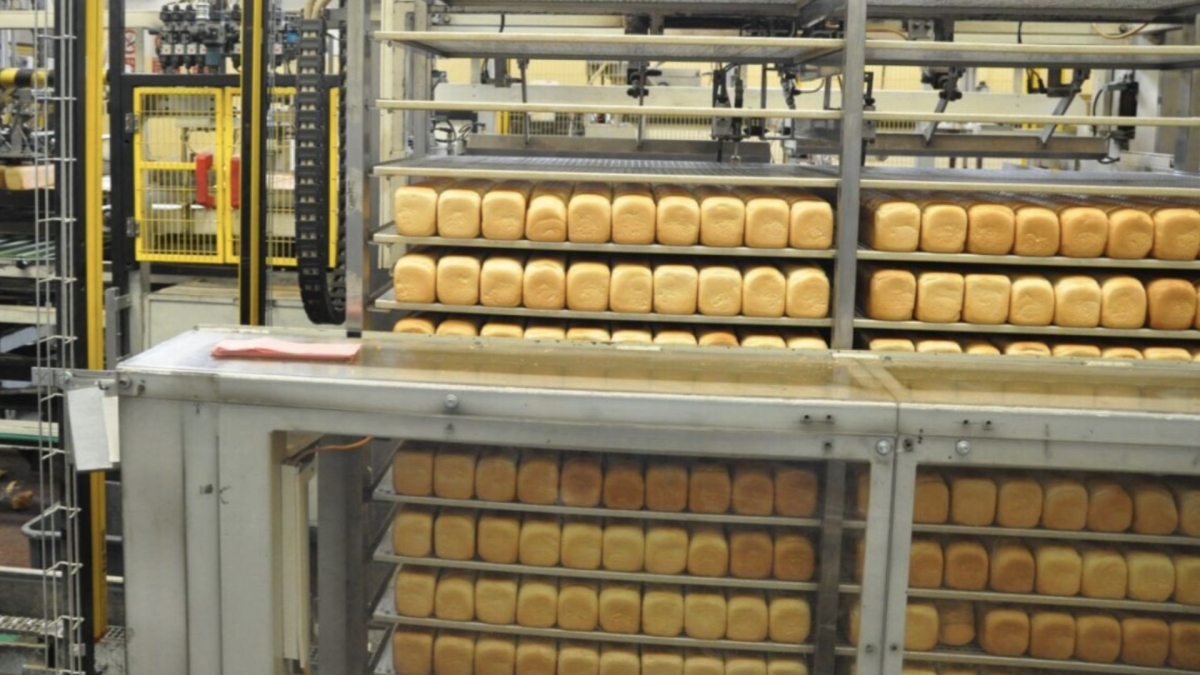
After baking, loaves move to a spiral cooling system that cools large bread volumes efficiently within a compact space.
Inside the spiral, loaves remain for 45–90 minutes, depending on product size and line speed. Forced air circulation removes heat, reducing core temperature from about 200°F to roughly 85°F before slicing and packaging.
High volumes of recirculated air enable fast cooling but can also carry airborne contamination if mold spores are present.
These spores often originate from raw material handling, packaging areas, or outdoor air infiltration. Continuous airflow inside the spiral can distribute spores throughout the enclosure, allowing them to settle on freshly baked loaves.
At this stage, the product is vulnerable. While baking greatly reduces microbial load, the bread remains warm and has high water activity (aw ≈ 0.95), conditions that favor microbial growth if contamination occurs.
Mold therefore, becomes visible days later as colonies develop between slices.
INTRODUCING UV-C DISINFECTION
To reduce contamination during the most sensitive stages of production, the company installed UV-C air disinfection systems in key areas of the line.
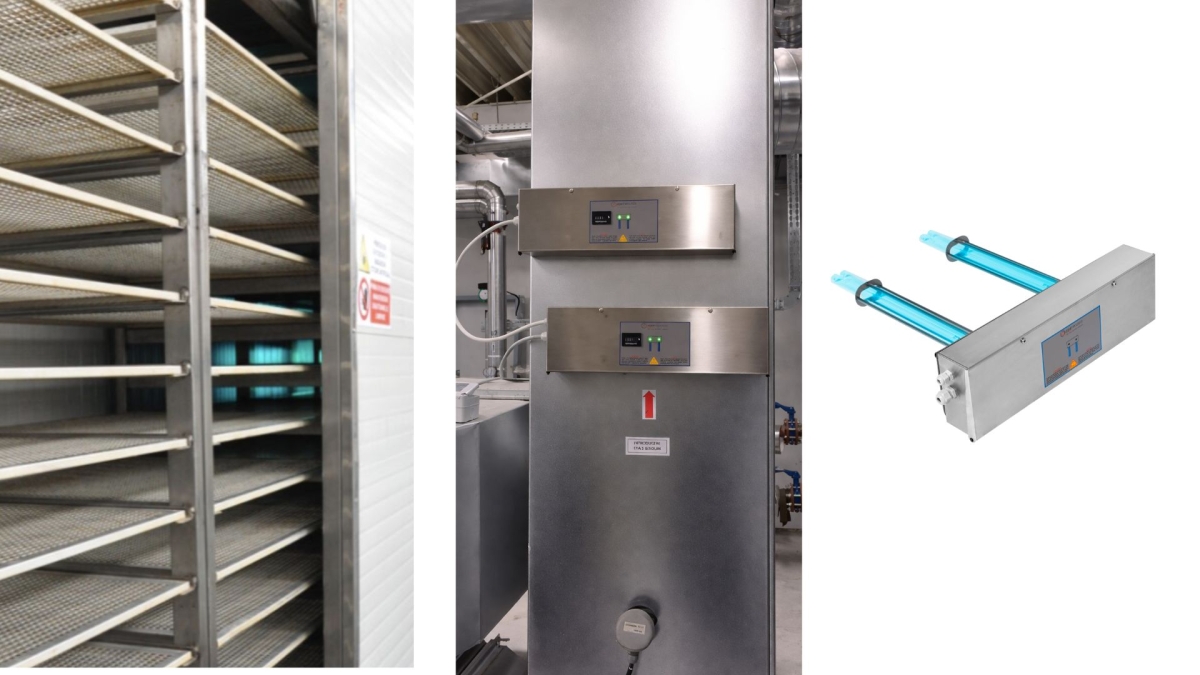
UV-C units were integrated into the spiral cooling process to treat recirculating air. By continuously disinfecting the air inside the cooling enclosure, the system reduces airborne mold spores before they reach the product.
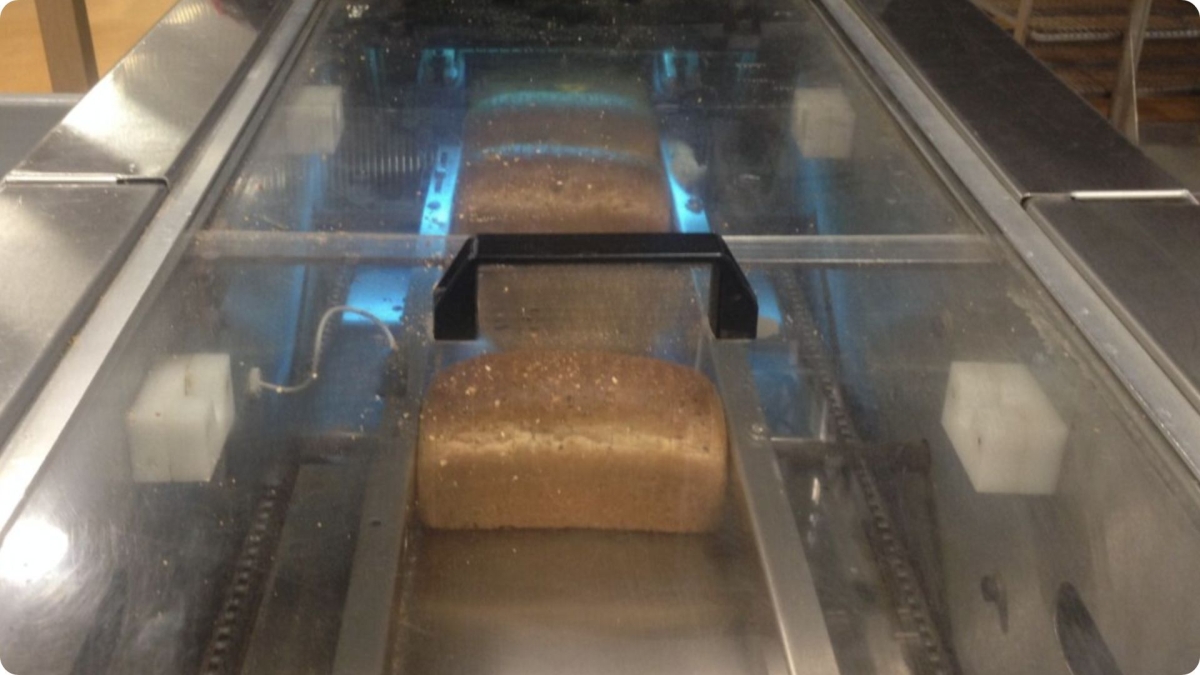
For added protection, UV-C surface units were installed upstream of the slicer, providing a final microbial reduction step on the loaf surface before slicing.
Critical Control Point
Cooling is one of the highest contamination risks in bakery production. Bread leaves the oven nearly sterile but quickly contacts surrounding air.
Installing UV-C air disinfection in spiral coolers continuously reduces airborne microbes, protecting product during its most vulnerable stage and helping extend shelf life.
RESULTS
After installing UV-C systems, the producer monitored airborne contamination and shelf life.
Results showed:
A case study about molds prevention, food safety and quality.
PROBLEM AT A GLANCE
For industrial producers of packaged sliced bread, micro-biological stability is a critical factor.
Even when baking processes are well controlled, the appearance of mold only a few days after production can significantly reduce product shelf life and lead to costly product returns.
IDENTIFYING THE SOURCE
Mold: the challenge faced by an industrial producer of sliced sandwich bread operating high-capacity production lines.
Despite strict control of raw materials, baking parameters, and packaging conditions, some packages began to show visible mold growth between bread slices after 4–6 days.
The production team initially questioned why mold appeared between slices rather than on the crust.
Microbiological testing ruled out contamination during dough preparation and baking. Bread leaves the oven with core temperatures above 95–98 °C, effectively eliminating most microorganisms. The investigation therefore focused on post-baking stages:
- loaf cooling
- transfer to slicing
- slicing and packaging
Mold Between Slices
If mold spores are present on the loaf surface, slicer blades can transfer them from the crust into the inner crumb as the loaf is cut.
Once packaged, the moist environment and residual oxygen allow these spores to germinate.
Mold therefore, becomes visible days later as colonies develop between slices.
If mold spores are present on the loaf surface, slicer blades can transfer them from the crust into the inner crumb as the loaf is cut.
Once packaged, the moist environment and residual oxygen allow these spores to germinate.
Mold therefore, becomes visible days later as colonies develop between slices.
CONTAMINATION POINTS
After baking, loaves move to a spiral cooling system that cools large bread volumes efficiently within a compact space.
Inside the spiral, loaves remain for 45–90 minutes, depending on product size and line speed. Forced air circulation removes heat, reducing core temperature from about 200°F to roughly 85°F before slicing and packaging.
High volumes of recirculated air enable fast cooling but can also carry airborne contamination if mold spores are present.
These spores often originate from raw material handling, packaging areas, or outdoor air infiltration. Continuous airflow inside the spiral can distribute spores throughout the enclosure, allowing them to settle on freshly baked loaves.
At this stage, the product is vulnerable. While baking greatly reduces microbial load, the bread remains warm and has high water activity (aw ≈ 0.95), conditions that favor microbial growth if contamination occurs.
Mold therefore, becomes visible days later as colonies develop between slices.
INTRODUCING UV-C DISINFECTION
To reduce contamination during the most sensitive stages of production, the company installed UV-C air disinfection systems in key areas of the line.
UV-C units were integrated into the spiral cooling process to treat recirculating air. By continuously disinfecting the air inside the cooling enclosure, the system reduces airborne mold spores before they reach the product.
For added protection, UV-C surface units were installed upstream of the slicer, providing a final microbial reduction step on the loaf surface before slicing.
Critical Control Point
Cooling is one of the highest contamination risks in bakery production. Bread leaves the oven nearly sterile but quickly contacts surrounding air.
Installing UV-C air disinfection in spiral coolers continuously reduces airborne microbes, protecting product during its most vulnerable stage and helping extend shelf life.
RESULTS
After installing UV-C systems, the producer monitored airborne contamination and shelf life.
Results showed:
- major reduction of airborne mold spores in cooling areas
- no mold between packaged slices
- improved shelf-life stability
1
We start with your system inputs
We select the appropriate UV configuration to deliver the required UV dose to the airflow at each pass or to product surfaces.
With just a few key inputs, we can accurately estimate the expected microbial reduction.
We select the appropriate UV configuration to deliver the required UV dose to the airflow at each pass or to product surfaces.
With just a few key inputs, we can accurately estimate the expected microbial reduction.
2
You see the results
The system adapts to your process. With over 40 years of experience in UV technology, our solutions are
engineered around your operating conditions, giving you greater process control and peace of mind.
The system adapts to your process. With over 40 years of experience in UV technology, our solutions are
engineered around your operating conditions, giving you greater process control and peace of mind.
“Once we focused on controlling airborne mold spores during the cooling phase, the situation improved quickly. During routine inspections, the auditors appreciated that we were taking a proactive approach to improving both safety and quality.”
Senior Quality Manager
Senior Quality Manager